Canada's Contentious Entry/Exit Program
- by Ronalee Carey Law
For years, immigration lawyers have been complaining of being shut out of IRCC’s online portal access for citizenship applications. Though unrepresented applicants can submit their applications online, lawyers are not permitted to use this particular portal. Instead, lawyers must courier citizenship applications to Sydney, Nova Scotia.
Having to create paper copies for citizenship applications is particularly annoying because IRCC requires a colour photocopy of every page of each passport (current or expired) held in the last five years for each country of citizenship. This includes blank pages. So, if you are representing a client who holds citizenship in two countries and has an expired and a current passport for each of those countries, that’s four passports, and every single page of each of those four passports needs to be copied, even if the page is completely blank. That’s a lot of pages.
Canada no longer routinely stamps passports for travellers entering Canada. Passports are scanned, and information is recorded electronically and entered into a database. Other countries do the same. Very few countries stamp passports for travellers leaving the country. We often see clients with extensive travel histories who don’t have a single stamp in their passports.
When applying for citizenship, applicants must show that they have met the physical presence requirement: they must have been in Canada for 1,095 days in the previous five years, unless working abroad as a crown servant or accompanying a family member who is working abroad as a crown servant. However, it is possible that in the future, IRCC will no longer need to rely on passport stamps to verify physical presence in Canada. Digital entry/exit records will theoretically be available for a full five years by November 2027.
IRCC’s Entry/Exit Program states that data collection for land entries between Canada and the USA began on July 11, 2019, with air mode starting on June 25, 2020. It took time to fully onboard all of the airlines, but this was expected to be completed by November 2022. Marine and train travel are also mentioned briefly, but no dates were given.
It is my hope that once a full five years of data is available for all modes of travel, IRCC will do away with the requirement to provide all pages of a passport for citizenship applications. Similarly, for permanent residence applications, there are onerous requirements to provide proof of residency in Canada. I am hopeful that applicants will no longer have to provide copies of their rental agreements, bank statements, pay stubs, and club memberships to prove they have been living here, because the government of Canada’s own entry/exit records will be sufficient to demonstrate they have been in the country.
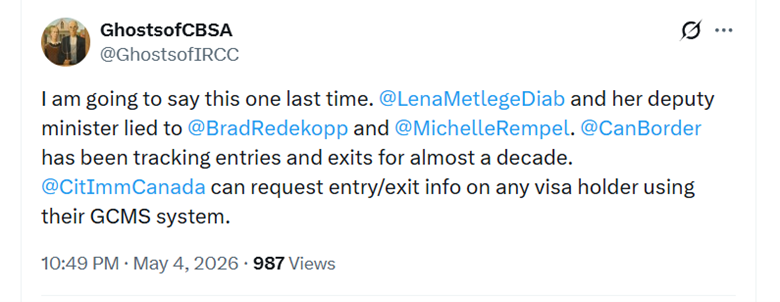
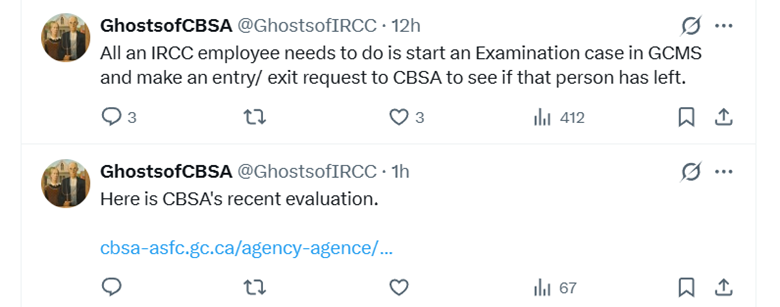
The Entry/Exit Program was in the news recently, and got the Immigration Minister into some hot water. As stated on the IRCC website, at the link noted above, the program has many uses, in addition to verifying physical presence for citizenship and permanent residence renewal applications. ‘Overstay’ data is also available in GCMS notes (accessible to IRCC and CBSA officers), indicating when someone had stayed longer than permitted by their visitor, worker, or student status. The program also notes that once fully implemented, CBSA officers would be able to use the data to determine if someone already in the country has stayed longer than they were authorized (and should be deported).
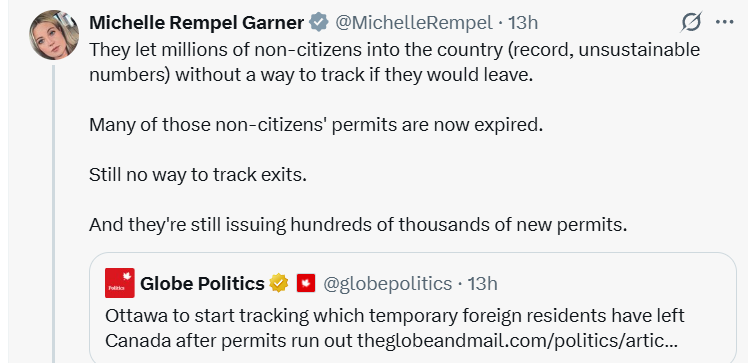
As reported in the Globe and Mail, a pilot program will be implemented to track the exits of some temporary residents, including international students. The pilot program comes on the heels of an Auditor-General report critical of the Immigration department’s failure to investigate cases of student permit non-compliance and fraud.
However, as scathingly pointed out on X, the Entry/Exit program already made accessible information on overstays and gave the authority to investigate individuals potentially overstaying (who were still in Canada):