
Spousal Sponsorships - Incomplete and Repeated Returns
- by Ronalee Carey Law
March 2026

In the summer of 2025, my firm did intake for two couples, both of whom had tried several times to submit a spousal sponsorship application on their own. Each time, their application was rejected by the Immigration Department for missing information or documents. At their wits’ end, they reached out to us for assistance. We resubmitted the applications, and both are now well on their way to finalization.
Both couples were native English speakers, well-educated and tech-savvy. Why, then, did they have so much trouble submitting their applications?
The IRCC website states that applicants do not need a representative to apply, as all forms and information are available free of charge on the website. And yet, we were unsurprised when we recently came across statistics that showed that IRCC returned approximately 27% of Spouse or Common-Law Partner in Canada Class applications due to incompleteness during the first 10 months of 2025:
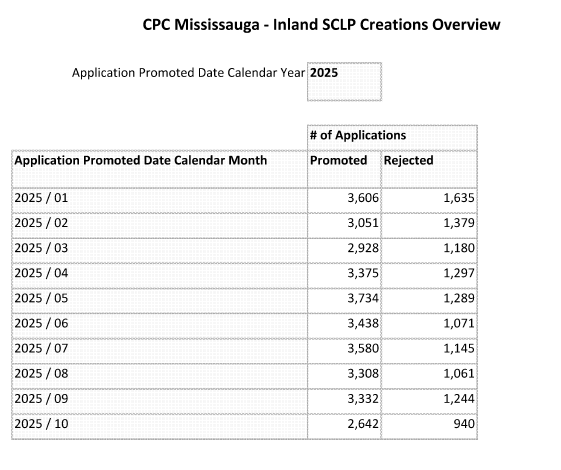
While we have not found comparable statistics for Family Class sponsorships, I suspect the data is comparable, as the same online portal and the same Document Checklist are used for both types of applications. Further, the couples who contacted us were both attempting to submit Family Class applications.
IRCC’s Permanent Resident Portal features several design elements that assist unrepresented clients throughout the sponsorship process. The portal itself links directly to the instruction guide and the main PDF forms for ease of access. The instructions are also available at the top of each page, including providing guidance on when to mark boxes as “not applicable”.
However, a sponsorship application has many moving parts. Even something as simple as marking the wrong box on the Document Checklist, so that the class of application doesn’t match the class you opened in the portal, can result in a returned application.
Other items that have IRCC sending back applications as incomplete are not items that unrepresented clients would ever know about or think to include. Not including a letter of explanation when the police certificate instruction page states that IRCC will provide a request letter at a later date is one example. Why would an unrepresented client think to remind the agent doing the completeness check of IRCC’s own internal policies?
Character limitations in the portal’s data boxes necessitate short forms, but a single missing mandatory data point can trigger a full return. Representatives often know when to submit an extra page, include an explanation in a letter of submission, or when nothing further is necessary. For example, a single family member’s missing postal code causes a full return, but writing “not applicable” for an email address is accepted.
For applicants, even knowing why their application was rejected is frustrating. On the permanent resident card side of the portal, you may not know the application has been returned unless you log in and check, as no email or other notification is sent. Luckily, the permanent resident application side of the portal at least provides a letter of return and greets you with a bright red box when you log back in to the main page:

The return letter will include a generic explanation of why the application was returned. It will state something like:

And you can then look at the form and play the fun game of “what from this list is missing”. A thorough review of one client’s IMM 5406 revealed a single missing postal code for one non-accompanying family member.
Consequence of Returned Applications
Applicants who must resubmit their application go back to the “end of the line,” and the processing time is the same as if they had never previously applied. Spouse or Common-Law Partner Inside Canada Class applications have a 21-month processing time, and Family Class applications are approximately 15 months for non-complex applications. Our firm is still awaiting a decision on a complex Family Class application submitted in September 2023, in which the clients received multiple “returned as incomplete” letters before contacting our firm. The couple married in November 2020 and are still separated by an international border while carrying the costs of two households. I can’t imagine the stress they are under, and how their marriage is handling the strain. For those living in Canada, extended processing times mean not being able to visit family back home for long periods.
A return of a sponsorship application may cause the principal applicant to lose their ability to work in Canada during processing if they had also submitted a work permit extension application. If the principal applicant is without status in Canada, having to resubmit an application will mean a longer wait time to apply for a work permit. Worse still, the return of an application can cause permanent family separation. Adult children who are close to 22 years old might not be able to be included in the subsequent application if they have a birthday in the intervening period.
IRCC’s promised new portal is intended to address some of the concerns, particularly regarding character limits. It’s an eagerly awaited project that will consolidate the various portals for different types of applications into one place. However, it remains to be seen whether implementing the new portal will result in fewer applications being returned as incomplete.